Ever look at your list for the day and think, “Yup, I can get all of this done.”
And then 5 pm rolls around and somehow… you didn’t.
You stayed busy. You checked things off. You moved from one task to the next.
And still, it feels like you fell short.
There’s a reason for that.
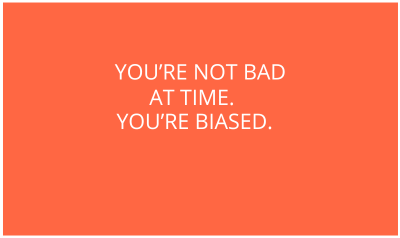
It’s called positivity bias.
- You naturally assume you’ll be faster, sharper, and more efficient than you actually are.
- You expect tasks to take less time.
- You believe this version of you will get more done than the version of you ever has.
So you build a day that looks doable on paper… but doesn’t hold up in real life.
Here’s how to stop overestimating what you can get done and start feeling more in control of your time.
#1 Assume the task will take longer than you think
Most estimates are based on a best-case version of reality.
“I’ve done this before.”
“This shouldn’t take long.”
“I’ll just knock this out quickly.”
But real life has interruptions, decisions, and extra steps that never make it into that estimate.
So instead of planning for speed, start planning for reality.
 |
If you think something will take 30 minutes, give it 45.
If you think it will take an hour, block 90.
This shift gives your day breathing room.
And when things do go smoothly, you gain time back instead of falling behind.
#2 Put everything on your calendar
It’s critical to understand that there is a gap between what you believe you can get done and what you can actually get done.
And the to-do list plays a big role in this.
It makes everything look equal.
Five tasks can feel just as manageable as fifteen because there’s no sense of time attached to them.
But your calendar tells the truth.
When you assign tasks to actual time blocks, you see how much space they take.
You see what fits.
And you see what needs to move.
That visibility changes your decisions before the day even starts.
Instead of hoping it all gets done, you’re making clear choices about what will.
#3 Break tasks down more than you think you need to
Big, vague tasks create false confidence.
I tend to do this with projects.
“Oh, it will just take me an hour.” Famous last words.
Your brain treats these like quick wins because it hasn’t fully processed the work involved.
Until the project is broken down into:
- Outline slides
- Draft three key points
- Create visuals
- Practice delivery
Now you can see what you’re actually committing to.
That’s where the real scope shows up.
Check out how the one hour in your head is nearly two hours in reality. (So frustrating — but important to realize!)
- Outline slides (15 min)
- Draft slides (45 mins)
- Create visuals (15 mins)
- Practice delivery (30 mins)
Now your time estimates start to match reality.
 |
The more specific the task, the more accurate your plan becomes.
The Bottom Line
You’re optimistic about what you can get done.
That optimism is powerful. It keeps you moving forward.
And it also quietly overloads your day.
When you plan with a little more honesty, everything shifts.
You give tasks the time they need.
You see your day more clearly
And you make better decisions up front.
So, at the end of the day, you don’t just feel busy.
You feel finished.
Xo,
Mridu
P.S. If your team consistently feels busy but not finished, it’s usually not a time issue. It’s a planning issue. That’s exactly what I help fix. Learn about training here or explore one-to-one coaching here.
P.S.S. Friends don’t let friends feel less stressed alone. Send this to your people.

Leave a Reply